- Sagging Floors
- Subfloor Repair
- Hardwood Repair
- Maryland
Sagging Hardwood Floor Repair in Maryland: Causes, Fixes, and Real Costs
Quick insights
- A sagging hardwood floor is almost never a hardwood problem. The boards follow whatever is under them. The real question is which layer has failed: the subfloor, the joists, the beam, or the posts and footings holding the beam.
- Soft and local (one spot gives underfoot) usually means subfloor. Bouncy across a room means joists that are undersized, over-spanned, or notched. A slope or dip toward the center of the house usually means the main beam or its posts.
- Residential building codes generally design floors to deflect no more than L/360 under load, about 3/8" over a 12-foot span. Floors from the 1920s–1950s were often framed with less margin than that, and decades of creep add to it.
- In Maryland, the usual suspects are damp crawlspaces and basements (rot and insect damage at sills and joist ends), plumbing and HVAC cuts through joists, and removed walls that were quietly carrying load.
- Typical Maryland ranges: $400–$1,200 for a localized subfloor repair, $300–$800 per joist to sister, $500–$1,500 per post for adjustable steel columns on new footings, plus the hardwood weave-in and refinish on top.
- Joist, beam, and post work is structural. Most Maryland jurisdictions require a building permit for it, and serious or widespread sagging should be looked at by a structural engineer before anyone jacks anything.
- Fix the cause before the floor. Refinishing or relaying boards over a moving or wet structure means paying for the same floor twice.
Which layer is actually sagging?
A hardwood floor is a stack: finish, boards, subfloor, joists, and under the joists a beam or bearing wall sitting on posts and footings. When the floor sags, one of those layers has moved, and the boards on top are just the messenger. Every honest repair starts by working out which one.
- The subfloor. The plank or plywood the hardwood is nailed to. When it fails you get a soft, local spot, usually a foot or two across, often with a squeak or a faint crunch. Common near tubs, toilets, sinks, dishwashers, exterior doors, and old radiator locations.
- The joists. When joists are too small for their span, have been notched or drilled for plumbing and ductwork, or have rot at the ends, the floor feels bouncy across a whole room. Dishes rattle when someone walks past the china cabinet.
- The beam and posts. The beam runs the length of the basement and carries the middle of the house. When a post settles, rusts, or rots at the base, the floor dips toward the center line, often with doors that stick and drywall cracks above the door frames upstairs.
How to check your floor before anyone quotes it
You can narrow this down in about twenty minutes with things already in the house.
The string or straightedge test
Lay a 6–8 foot level or a straight board across the low area, or pull a string tight between two points along the wall. Measure the gap at its deepest point. A gap of 1/4" or less over a room is common in older houses and often cosmetic. Anything past 1/2", or a dip you can see from the doorway, deserves a look from below.
The bounce test
Stand still in the middle of the room and have someone walk heavily past you. If you feel it through your feet or see a lamp shade sway, the joists are deflecting more than they should.
Go downstairs
If you have a basement or crawlspace, take a flashlight under the problem area and look for:
- Dark staining, soft wood, or white or brown fungal growth on joists, sill plate, or subfloor underside. Push a screwdriver in. Sound wood resists; rotted wood lets it sink.
- Joists that have been notched or cut through for drain lines, ductwork, or a long-ago bathroom remodel.
- Small holes and fine powdery frass (wood-boring beetles) or mud tubes on the foundation (termites). Both are common in Maryland.
- Posts that are wood sitting directly on dirt, rusted steel columns, shims stacked under the beam, or a post leaning out of plumb.
- Standing water, damp soil, or a musty smell. A crawlspace with high humidity keeps rotting the framing no matter what you fix upstairs.
Note what moved recently
New sag after a remodel almost always means a wall that was carrying load came out, or joists were cut. New sag after a wet season usually means moisture. Slow sag over decades is more often creep in undersized framing.
Why Maryland floors sag
The housing stock here explains most of what we see.
Older framing with less margin. The 1920s–1950s homes across Silver Spring, Takoma Park, and Chevy Chase were framed before modern span tables, often with 2x8 joists on long spans and a plank subfloor running diagonally. Seventy or more years of load let the wood creep. The floor has been slowly sagging since before you bought the house.
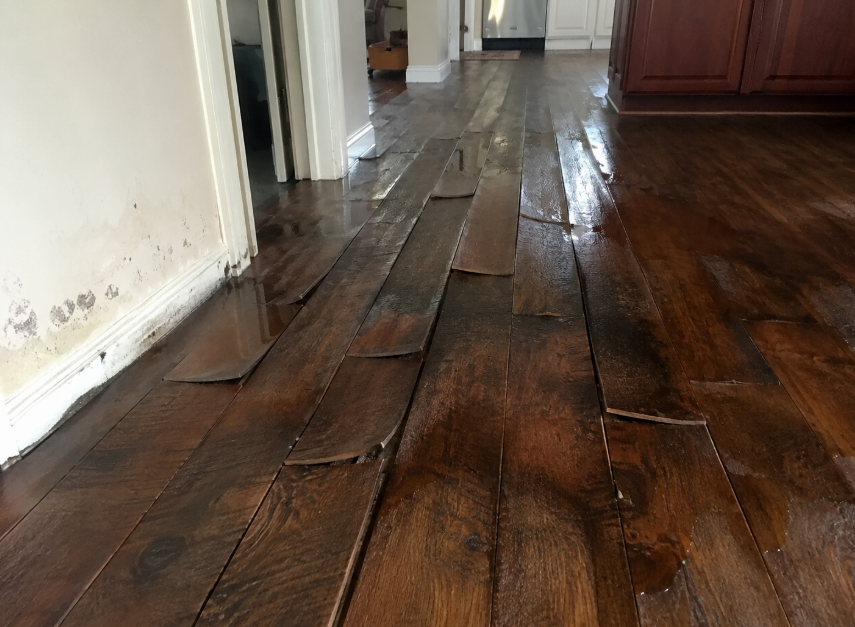
Moisture below grade. Maryland summers are humid, and many basements and crawlspaces never fully dry. Damp air feeds rot at the sill plate and joist ends, and the softened wood gives way under load. Waterfront and low-lying properties around Annapolis see this more than most. If there has been a leak or flood in the space, read our guide to water-damaged floor repair, because drying comes before any structural fix.
Remodeling cuts. A bathroom added in the 1970s, a new drain line, a duct run, a kitchen island with plumbing. Each one tempts someone to cut a notch in the bottom of a joist, which is the part that carries the most tension. We find this under kitchens and bathrooms all the time.
Removed walls. Open-plan renovations in split-levels and colonials in Rockville, Olney, and Germantown sometimes took out a wall that was quietly supporting the floor above. The sag shows up a few years later along the old wall line.
Heavy point loads. A cast-iron tub, a stone countertop island, a piano, a large aquarium, or a gun safe concentrated on joists that were sized for normal living loads.
The fixes that actually work
Each fix matches a layer. Doing the wrong one wastes money, and that's the most common mistake we're called in to correct.
Subfloor repair
For a soft local spot: pull the hardwood over the area, cut out the failed subfloor back to solid wood, add blocking between joists so every edge of the patch is supported, and install new plywood glued and screwed to the framing. Then the hardwood is woven back in with staggered seams and blended. If the cause was a leak, the leak gets fixed and the area gets dried and metered first.
Sistering joists
For a bouncy room or a joist that's cracked, notched, or rotted: a new full-depth joist is fastened alongside the old one, glued and bolted or structurally screwed, ideally bearing on the same supports at both ends. Sistering restores stiffness without tearing out the floor above. Where a long section of rot is present, the damaged wood is cut out and the joist is supported by the new member.
Blocking and bridging
Solid blocking or cross-bridging between joists at mid-span spreads load across neighboring joists and cuts bounce noticeably. It's inexpensive and often combined with sistering.
Mid-span beam or new posts
For a dip toward the center or a long, flexible span: add a beam under the joists at mid-span on adjustable steel columns, each sitting on a properly sized concrete footing. Columns sitting on a bare basement slab can punch through or settle, which is why footings matter.
Jacking, slowly
When a floor has dropped, lifting it back takes patience. Screw jacks are raised in small increments over days or weeks, not hours. Lift too quickly and you crack plaster, rack door frames, and split old boards. Some sag in very old houses is best stabilized where it is rather than forced back level.
Then the hardwood
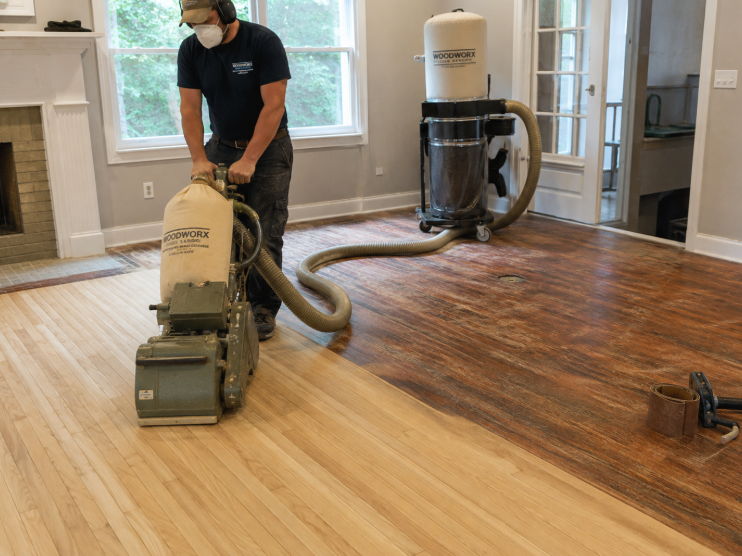
Once the structure is stable, we deal with the floor itself: re-nailing loose boards, replacing cracked or cupped ones with matching stock, and, where the floor is now flat enough, a full sand and refinish so the repaired area blends in. If a floor has dipped for decades, sanding can flatten small high spots, but it cannot fix a structural sag. Trying to sand a dip flat only burns through the wear layer.
Permits, engineers, and who should do what
Flooring and framing are separate trades, and the line matters.
- Subfloor patches and board replacement are flooring repair. A licensed Maryland home improvement contractor (MHIC) can handle them.
- Sistering joists, adding beams, posts, or footings, and jacking are structural. Most Maryland jurisdictions, including Montgomery County's Department of Permitting Services, require a building permit for structural alterations. Check with your county or city permit office before work starts.
- Widespread sag, cracked beams, foundation movement, or sag after a wall was removed should be evaluated by a licensed structural engineer. A stamped repair plan protects you, makes permitting easier, and settles questions at resale.
- Active termite or beetle activity needs a licensed pest control company before any wood goes back in.
We handle the flooring layers and coordinate with the structural side when it's needed, so you get one schedule and one point of contact instead of three trades guessing about each other.
What sagging floor repair costs in Maryland
These are typical Maryland ranges from our own work, before any engineering or permit fees. Most jobs combine two or three lines.
The biggest cost driver is access. A full-height unfinished basement is the cheapest place to fix a floor. A finished basement ceiling has to be opened and patched. A tight crawlspace slows everything. And with no access below at all, as in some slab-adjacent additions, the hardwood and subfloor have to come up from above.
Homeowner insurance in Maryland generally excludes gradual deterioration, rot, and insect damage. Sag caused by a sudden covered event, like a burst pipe, may be a different story, so document it and call your carrier first in that case.
When to call us
Call when a spot feels soft underfoot, the floor bounces enough to rattle things, a dip is visible from the doorway, doors have started sticking, or you are planning a refinish and want the floor flat first. Call sooner if you see rot, insect damage, or water below.
On the visit we measure the sag, check the hardwood and its moisture content, go below to look at the subfloor, joists, beam, and posts, and tell you which layer is failing. You get a written, itemized quote with flooring and structural items broken out separately, honored for 60 days. If it needs an engineer first, we'll tell you that up front.
Call (240) 343-3514 or request a free estimate. See our hardwood repair & restoration service, or go straight to your town: Bethesda, Rockville, Silver Spring, Chevy Chase, Potomac, Takoma Park, Olney, Germantown, Annapolis, or Frederick. Related reading: pet urine damaged wood floors and hardwood floors in a Maryland winter.
Sources
- International Residential Code, Chapter 3 (Table R301.7) — allowable floor deflection of L/360.
- Montgomery County Department of Permitting Services — residential building permit requirements.
- National Wood Flooring Association — subfloor and moisture requirements for wood flooring.
Pricing reflects our own Maryland rates; structural costs vary with access, engineering, and permit requirements.