- Stairs
- Hardwood Installation
- Montgomery County
- Maryland
Carpet to Hardwood Stairs in Maryland: Cost Per Step, Code Traps & Retrofit vs. Full Treads
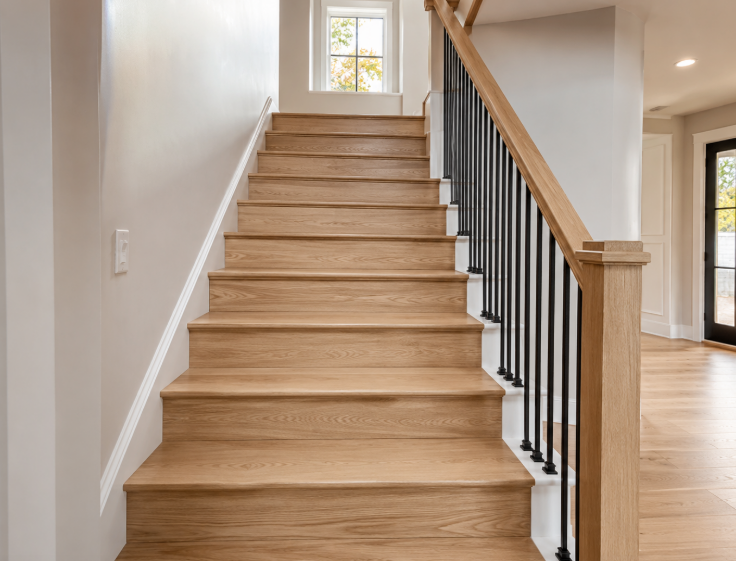
Quick insights
- Typical Maryland pricing for a carpet-to-hardwood stair conversion is $150–$250 per step for demo, new solid treads and risers, and site finishing — so a standard 13–14 step flight lands around $2,000–$3,500 before railings or landings.
- Your stairs may already be oak. Many 1950s–1970s Maryland colonials have finish-grade oak treads under the carpet; most 1980s and newer builds have construction-grade pine or OSB that was never meant to be seen. Pull one corner on one step before you price anything.
- The code trap is the top and bottom riser. Maryland enforces IRC R311.7: risers max 7¾", and every riser in a flight within ⅜" of the others. Retrofit caps stacked on old treads raise the bottom step and shrink the top one — the classic trip hazard.
- Retrofit treads are fine when the old treads are flat, solid, and the geometry works. Full tread replacement is the right call when the existing treads are particleboard, bowed, or would push any riser out of tolerance.
- Stain-match is a stairs-and-floor decision, not a stairs decision. New oak treads next to a 30-year-old amber floor never match until both are finished together — which is why we often quote a refinish alongside.
- Replacing treads in kind usually doesn't need a permit; changing stringers, rise/run, guards, or the railing system generally does. Your county — or the City of Annapolis or Frederick — makes that call.
First: find out what's actually under your carpet
Before you budget anything, pull back the carpet at the edge of one step — the side against the wall, where nobody will see the test. What you find decides the whole project.
- Finish-grade oak treads with a rounded nosing. Common in 1950s–1970s colonials and splits in Rockville, Silver Spring, and Bethesda, where stairs were carpeted later. Expect tack strip holes and staple fields along every edge. These can often be sanded and refinished — the cheapest path by far.
- Construction-grade pine or fir treads, square edge. Typical of 1980s–2000s builds in Germantown, Clarksburg, and Olney. Soft, knotty, and usually the wrong height for a finished nosing. Plan on new treads.
- OSB, particleboard, or plywood “carpet-grade” treads. Never meant to be seen and can't be finished. Full replacement, and this is where checking the stringers matters.
Also look at the risers (painted? drywall? plywood?) and whether there's a skirt board along the wall. A clean skirt lets new treads scribe in tight; no skirt means more trim work, and a ragged drywall edge is the line most DIY conversions can't hide.
Retrofit caps vs. full tread replacement
There are two legitimate ways to do this, and plenty of illegitimate ones. The difference is mostly about height.
Retrofit (cap) treads
A thinner hardwood tread — usually around ⅝" to ¾" with a built-in nosing — glued and fastened over the old tread after the existing nosing is cut flush. Risers get a thin oak or primed-poplar overlay. Less demo, less dust, faster. It works well when the old treads are flat and solid, and when the extra thickness can be absorbed at the top and bottom of the flight.
Full tread replacement
Old treads come out to the stringers, and new 1" solid treads (oak is standard, white oak and hickory on request) go in, glued and screwed or nailed into each stringer. More work, but it resets the geometry: you get real nosing, a solid feel underfoot, and no stacked thickness. If the old treads are particleboard, squeaky, cracked, or bowed, this is the only version we'll quote.
What we won't do
Bend a floor plank over the edge of a step, glue a strip of laminate to a carpet-grade tread, or install a nosing that isn't rated for stair use. Those are the stairs we come back and rip out two years later. The same rule applies to vinyl — purpose-made stair parts, never bent planks — if you're weighing that option instead (see our LVP vs. hardwood comparison).
The riser-height code trap at the top and bottom step
This is the part a lot of installers skip and inspectors don't. Maryland adopts the International Residential Code statewide, and section R311.7 sets the geometry every residential stair is held to:
Here's the problem. Every intermediate step gets the same added thickness, so their risers stay equal. But the bottom riser grows by the full thickness of the new tread, and the top riser shrinks by it — because the floor up there doesn't move. Add ¾" of retrofit over the old tread and you've just put both ends of the flight ¾" out of step with the middle. That's over the ⅜" tolerance, and it's exactly the kind of mismatch your foot doesn't expect.
The fixes are known, and a good installer picks one before starting: full replacement instead of capping, a thinner cap where the stairs allow, adjusting the bottom landing or the top floor transition, or (when the upstairs floor is being replaced too) raising the top landing with the new floor. We measure every riser on the flight with the carpet still down and put the numbers on the quote. If your current stairs are already out of tolerance — common in older houses in Takoma Park and Chevy Chase — we'll tell you before anything comes up.
Permits: replacing tread surfaces in kind generally doesn't require one. Changing stringers, rise or run, guards, balusters or the railing system usually does. Montgomery, Howard, Anne Arundel, Frederick and Prince George's counties enforce it locally, and the cities of Annapolis and Frederick issue their own permits — confirm with the office for your address before work that touches structure or railings.
What a carpet-to-hardwood stair conversion costs in Maryland
These are our own Maryland rates, scaled by town on each stair service page — not a national calculator average.
What moves the price: open vs. closed stringers (an open side with returned nosings is real carpentry), winders and landings, a bullnose starter step, species (white oak and hickory cost more than red oak), and whether the risers are painted (cheaper, cleaner look) or stained oak. A basic 13-step closed flight in a Germantown colonial and a curved open flight with a bullnose in Potomac are different conversations.
Value-wise, stairs punch above their size. They're the first thing seen from the front door in most colonials, and carpet on oak stairs is one of the most common “dated” notes in Montgomery County listings.
Making the stairs match the floor they land on
New oak treads are pale. A 25-year-old oak floor with an oil-based finish has ambered to a warm orange. Stain them separately and they'll never match — the woods take stain differently, and the old finish keeps shifting color.
The clean way is to finish stairs and floors together: sand the hall and landing, then stain and coat everything as one system on the same day with the same samples. If the upstairs is still carpet, it's worth asking whether there's oak under that too — the same rules from our replace-or-refinish guide apply, and refinishing what you already own almost always beats new. If you're laying new floors, install first and do the stairs in the same finish schedule (see hardwood installation).
Two practical notes. Finish choice: stairs take the most concentrated wear in the house, so we spec a commercial-grade waterborne polyurethane, three coats, with a satin or matte sheen — gloss on stairs shows every scuff and is genuinely slipperier. Timing: plan on one to two days without the stairs; we can finish alternate steps on multi-level homes so you're never locked upstairs.
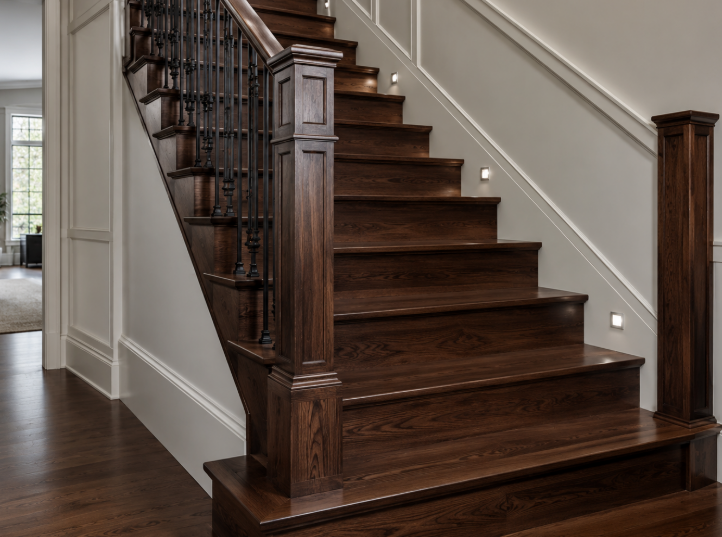
Slippery stairs, dogs and kids
The number-one worry we hear: “Won't hardwood stairs be slippery?” Bare, glossy treads in socks — yes. Satin or matte finish, a proper rounded nosing, and a continuous handrail make an enormous difference. For older dogs, low-profile adhesive tread pads or a runner fastened with stair rods keep the look and the grip; just avoid rubber-backed mats that trap moisture and discolor the finish underneath.
If the dog has been having accidents on the old carpet, deal with that first — urine soaks through carpet and pad into the tread and stringer exactly the way it does on a floor. Our guide to pee-damaged wood floors covers the sealing step, and it applies to stairs too.
When to schedule it
Fall is the best window in Maryland: indoor humidity is moderate, the furnace isn't running hard yet, and the house can stay ventilated while finish cures. Solid treads installed in a damp August and finished tight will gap a bit once the heat comes on; treads installed in a dry January can swell at the seams by July. Either way, we acclimate the stock in the house and hold indoor humidity at 30–50% — more on why in our post on hardwood floors in a Maryland winter.
When to call us, and what we'll actually do
On the visit we pull one corner to see what's under the carpet, measure every riser and tread on the flight, check the stringers for squeaks or movement, look at where the stairs meet each floor, and bring stain samples for the finish you already have. You get a written, itemized quote per step — demo, treads, risers, nosings, trim, finish, and any railing work broken out separately — honored for 60 days.
Call (240) 343-3514 for a free in-home estimate. Start with stair installation, or go straight to your town: Bethesda, Rockville, Silver Spring, Potomac, North Bethesda, Olney, Germantown, Clarksburg, Annapolis, Frederick, or Clarksville.
Sources
- International Code Council, IRC R311.7 Stairways — riser, tread, nosing, headroom and handrail requirements, adopted statewide through the Maryland Building Performance Standards.
- National Wood Flooring Association — acclimation and the 30–50% relative humidity service environment for wood flooring.
Pricing reflects our own Maryland rates across Montgomery, Howard, Anne Arundel, Frederick, and Prince George's counties.