- Luxury Vinyl
- Condos
- Bethesda
- Rockville
- Montgomery County
Best LVP and LVT for Bethesda and Rockville Condos
Quick insights
- Your bylaws pick the floor before you do. Nearly every Bethesda and Rockville condo above the ground floor requires a rated sound assembly — commonly IIC and STC 50 minimum, and 55 or higher in the downtown high-rises. Ask for the number in writing before you shop planks.
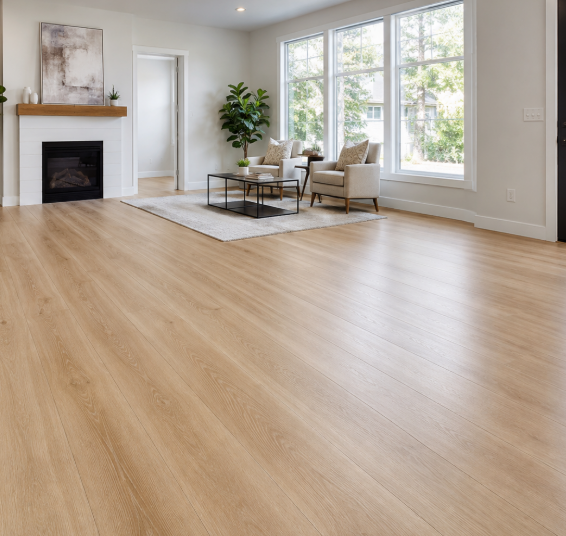
- Rigid core (SPC) click-lock LVP with an acoustic underlayment is the default winner in condos: dimensionally stable over a concrete slab, waterproof, and easy to pair with a tested underlayment that gets you to the rating.
- Glue-down LVP and LVT are the high-rise answer when the board wants no floating floor, when there are rolling loads, or when a slab is too wavy for click joints to survive. Glue-down also kills the hollow “click” sound neighbors complain about.
- Brands we install most: COREtec and Shaw Floorté, Mohawk SolidTech, Mannington Adura (Max, Rigid, Flex), Karndean Designflooring (Korlok and LooseLay), and AHF/Armstrong rigid core. Value tiers — MSI Everlife, Pergo Extreme, NuCore — are fine for rentals when the wear layer is right.
- Spec that matters more than brand: a 20 mil (0.5 mm) wear layer for an owner-occupied condo, 28–30 mil for a rental, 5–8 mm total thickness, and FloorScore certification for indoor air quality in a sealed high-rise unit.
- Typical installed cost: about $4.50–$7.00 / sq ft in Rockville and $5.00–$7.75 / sq ft in Bethesda for rigid-core LVP, plus $1–$2.75 / sq ft where the slab needs leveling. A 1,100 sq ft condo usually lands between $6,000 and $9,500 all-in.
- The slab decides the schedule. We moisture-test concrete before any glue-down goes in, and we flatten before we install — vinyl telegraphs every dip in a 1970s slab.
Why a condo floor is a different job than a house floor
We install the same luxury vinyl in a Rockville split-level basement and a Bethesda high-rise, and the material is the easy part. In a condo, three things are true that are not true in a single-family house:
- Someone lives under you. Impact noise — heels, dropped keys, a dog's nails — travels straight through a concrete slab unless the assembly is designed to stop it. That is what your bylaws' sound rating is about.
- You are installing over concrete, not plywood. Slab moisture, slab flatness, and slab age all drive the spec. Solid hardwood is off the table below grade and on most slabs; this is exactly the gap LVP and LVT were built for.
- The building is a second client. Approval packets, certificates of insurance, elevator reservations, protection of common hallways, and work-hour windows are all part of the job. We handle all of it in the King Farm and Town Center buildings in Rockville and in the Woodmont Triangle and Bethesda Row high-rises, and increasingly in the Grosvenor and Pike District buildings in North Bethesda.
Under Maryland's Condominium Act, you can generally alter the inside of your unit, but you cannot touch a common element without the council of unit owners' permission — and in most buildings the floor assembly sits right on that line, because the slab beneath your finish floor is a common element. That is why “I'm just replacing my flooring” still goes through the board.
The sound rating: the number that actually picks your floor
Two ratings show up in condo documents. IIC (Impact Insulation Class) measures impact noise — footsteps and dropped objects. STC (Sound Transmission Class) measures airborne noise — voices and TV. The single-number IIC rating comes from a tapping-machine test on a floor/ceiling assembly, classified under ASTM E989; higher numbers mean more impact sound is stopped.
What we see in Montgomery County buildings:
- IIC/STC 50 minimum is the common floor in bylaws for mid-rise and garden-style condos in Rockville and the older Bethesda buildings.
- IIC/STC 55–60 is routine in the newer downtown Bethesda high-rises and some King Farm buildings, often with a required underlayment product named by brand.
- Ground-floor units over a garage or over nothing are frequently exempt — worth checking, because it widens your options and cuts cost.
Three practical warnings. First, a rating belongs to an assembly, not a plank: the number comes from the floor, the underlayment, the slab, and the ceiling below, tested together. A manufacturer's “IIC 71” was measured on their lab's slab-and-ceiling, not yours. Second, an attached IXPE or cork pad on a rigid-core plank is usually not enough on its own for a 55+ building; you will need a separate acoustic underlayment rated for the assembly. Third, many boards want the manufacturer's test report submitted with your approval packet, so pick a product that actually has one.
If the board rejects your first submission, that is normally a spec problem, not a politics problem, and it is fixable in a day. We will re-spec against the number and resubmit.
The four constructions we install, and which belongs in a condo
LVP and LVT are the same waterproof material in different clothes: plank mimics wood, tile mimics stone or ceramic. What changes the job is how the floor is built and how it attaches.
1. SPC rigid core, click-lock (our most-installed condo floor)
A stone-plastic composite core — dense, thin, and dimensionally stable. It barely moves with temperature, which matters in a sun-facing high-rise unit with floor-to-ceiling glass, and it bridges minor slab imperfections better than a flexible plank. Floats over an acoustic underlayment. Typical 5–7 mm with a 12–30 mil wear layer. This is what goes into most Rockville and Bethesda condos we touch.
2. WPC rigid core, click-lock
A wood-plastic composite core — thicker, lighter, softer and warmer underfoot than SPC, with a bit more sound deadening built in. Good in bedrooms and in units where comfort beats dent resistance. It expands slightly more than SPC, so it needs honest expansion gaps at every wall and column.
3. Glue-down (dryback) LVP and LVT
Planks or tiles bonded directly to the slab with adhesive. No floating layer means no hollow click underfoot, the lowest profile at thresholds and elevator-lobby transitions, and no risk of a floating field pushing against a kitchen island. It is our recommendation when the board bans floating floors, in rentals near downtown Bethesda, and anywhere with rolling loads. The trade-off: the slab must be genuinely flat and moisture-tested first, and removal later is a bigger job — see our LVP and LVT removal guide.
4. Loose-lay and groutable LVT
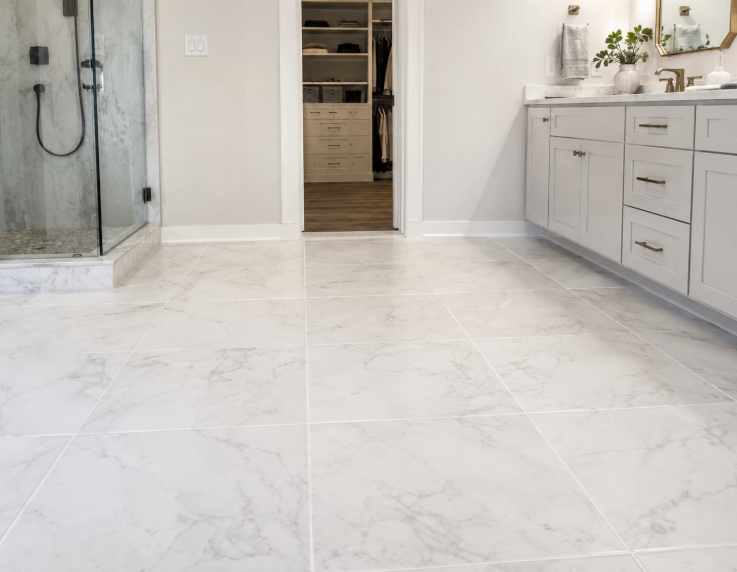
Loose-lay planks (heavy, friction-backed, usually perimeter-glued) are the serviceable choice over a slab with a questionable moisture history, because individual planks lift and go back. Groutable LVT gives you a real grout line in a condo kitchen, bath, or entry at a fraction of a porcelain install's weight — relevant when a board is worried about load.
The most popular types we install, in order
- SPC rigid-core LVP, 20 mil wear layer, 7–9" wide plank, light-to-mid oak visual — the default owner-occupied condo floor in both cities.
- Glue-down LVP with a commercial wear layer — high-rises, rentals, and investor units.
- LVT in stone and ceramic visuals — kitchens, baths, laundry closets, and entry foyers.
- Groutable LVT — when the tile look has to read as real tile.
- WPC rigid core — bedrooms and comfort-first installs.
A very common Bethesda and Rockville condo package is one coordinated line: wide-plank LVP through the living area and bedrooms, matching LVT in the baths and laundry, with a single color story and flush transitions.
Major brands: what we install and where each one fits
We are not a single-brand dealer, so this is a working opinion, not a sales sheet. Every brand below makes products we would and would not put in a condo — the line and the spec matter more than the logo.
Premium and designer
- Karndean Designflooring — Korlok (rigid core), LooseLay, and the Van Gogh and Knight Tile glue-down ranges. The best visuals in the category and a favorite in downtown Bethesda renovations; LooseLay is our pick for slabs with a moisture question.
- COREtec (Shaw) — the brand that popularized rigid core. The Pro and Premium lines with an attached cork pad are condo-friendly and widely accepted by boards.
- Mannington Adura — Adura Max (WPC), Adura Rigid (SPC), and Adura Flex (glue-down) cover all three constructions in one coordinated color line, which is useful when plank and tile have to match room to room.
Mainstream and widely stocked
- Shaw Floorté and Floorté Pro — broad range, strong warranties, easy to source quickly for a turnover deadline.
- Mohawk SolidTech and SolidTech Plus — dependable rigid core, good dent resistance for the price.
- AHF Products / Armstrong Flooring lines (Luxe, Rigid Core Vantage) — a long-established commercial pedigree that reads well in a board submission.
Value and rental tiers
- MSI Everlife (Cyrus, Prescott, Andover), Pergo Extreme, NuCore, Lifeproof — perfectly serviceable in a rental when you buy the thicker wear layer. Where these go wrong is a 6–12 mil wear layer in a high-traffic unit.
Underlayment brands worth knowing
In a 55+ IIC building the underlayment is as much a spec decision as the plank. QuietWalk Plus, FloorMuffler, and the MP Global acoustic range are the products we submit most often, chosen against the specific rating your bylaws demand and the test report the board wants to see.
One honest note: if you are weighing vinyl against real wood for a main living level, read our LVP vs. hardwood comparison for Montgomery County first. In a condo over a slab, engineered hardwood glued down with a sound mat is the only wood option that works, and we install that too — see hardwood installation in Bethesda and in Rockville.
The five specs that decide whether the floor lasts
- Wear layer. This, not thickness, determines how long the floor looks new. 12 mil is light residential; 20 mil (0.5 mm) is the right owner-occupied condo spec; 28–30 mil for rentals, dogs, or a unit that gets rolled luggage every week.
- Overall thickness and core. 5–8 mm for SPC, 6.5–8 mm for WPC, 2–3 mm for glue-down. Thicker is not automatically better; a thick plank over a wavy slab still fails at the joints.
- Slab moisture. Concrete emits moisture for years, and in Rockville's 1960s–70s buildings and Bethesda's older mid-rises we have found slabs that were never a problem under carpet and are very much a problem under adhesive. We test in-situ relative humidity in the slab before any glue-down and match the adhesive to the reading.
- Flatness. Vinyl telegraphs everything. We flatten to the manufacturer's tolerance with a cementitious leveler before installing — budgeted at $1–$2.75 / sq ft in Bethesda and $1–$2.50 / sq ft in Rockville, and quoted up front rather than discovered on day two.
- Indoor air quality. A sealed high-rise unit does not air out. We specify FloorScore-certified products, the resilient-flooring indoor air quality certification administered by the Resilient Floor Covering Institute with SCS Global Services, which tests hard-surface flooring and adhesives against VOC emissions criteria. All the major brands above have FloorScore-certified lines; ask for the certificate if nobody offers it.
What it costs in Bethesda vs. Rockville
Installed, material and labor, from our own current pricing. Bethesda runs about 12% above Rockville on labor, which is the difference between the two columns.
Installed, per square foot, material and labor.
For a typical 1,100 sq ft two-bedroom condo, a rigid-core LVP job with an acoustic underlayment, new base shoe, and normal prep lands around $6,000–$8,500 in Rockville and $6,800–$9,500 in Bethesda. Add the cost of removing what is down now (about $1–$2 / sq ft for floating vinyl or carpet, $2–$4 for glue-down), plus disposal — a real line item in a building where everything leaves by elevator.
Budget separately for an acoustic underlayment in a 55+ IIC building; the rated products are meaningfully more expensive than a generic foam, and substituting one is the single fastest way to fail an inspection.
The building side: approval packet, COI, elevator, and hours
What we put together for a Bethesda or Rockville board, usually two to four weeks before the install:
- Alteration/renovation application with the product name, construction, and underlayment.
- Manufacturer test data showing the assembly's IIC and STC against your bylaws' number.
- Certificate of insurance naming the association and the management company as additional insured, at the limits your documents require.
- Our MHIC license and contractor information.
- Schedule within the building's permitted work hours — typically weekdays, 9am to 5pm, no weekends in most downtown Bethesda buildings.
- Elevator reservation and a plan for hallway and lobby protection.
Day of: material comes up on the reserved elevator, we protect the corridor, old floor comes out, the slab gets tested and flattened, underlayment and floor go down, base shoe and transitions finish it. A 1,100 sq ft unit is typically two to three working days, plus prep time if the slab needs leveling and cure time.
One thing we find more often than anyone expects: a slow supply-line or dishwasher leak that the old floor was hiding. If the slab or the sill plate is wet when we open it up, we will stop, photograph it, and tell you before we proceed — that is a water damage repair conversation, and in a condo it is also an insurance and association conversation. If the unit has an interior stair (common in the townhouse-style condos in King Farm), the stair system has to be specified with the floor, not after it.
The short answer, by unit type
- Downtown Bethesda high-rise, IIC 55+: glue-down LVP or LVT from Karndean, Mannington Adura Flex, or an AHF commercial line, over a moisture-tested, flattened slab. Quietest underfoot, lowest profile, easiest board approval.
- Mid-rise or garden condo, IIC 50: SPC rigid-core LVP, 20 mil wear layer, over a rated acoustic underlayment. COREtec, Shaw Floorté, Mohawk SolidTech, Adura Rigid.
- Rockville King Farm or Town Center unit: SPC rigid core for owner-occupied, glue-down for rentals. Plan the elevator and COI early; these buildings enforce their rules.
- Investor or rental unit: glue-down LVP with a 28–30 mil commercial wear layer. It survives turnovers and spot-repairs plank by plank.
- Ground-floor unit with no neighbor below: you have the widest choice and the lowest cost — and engineered hardwood glued to the slab becomes a genuine option. Compare both on our LVP and LVT hub and hardwood installation hub.
- Slab with a known moisture history: loose-lay LVP, or a moisture-mitigating adhesive system, after in-situ RH testing. Never a wood product.
Call (240) 343-3514 for a free in-home estimate. We will read your bylaws with you, spec to the rating, and give you a fixed written number honored for 60 days — or start with your building's town: LVP & LVT in Bethesda, LVP & LVT in Rockville, North Bethesda, Chevy Chase, or Silver Spring. You can also request a fixed quote online.
Sources
- ASTM E989, Standard Classification for Determination of Impact Insulation Class (IIC) — how the single-number IIC rating is derived from tapping-machine impact sound testing of a floor/ceiling assembly (test method ASTM E492).
- Resilient Floor Covering Institute (RFCI), FloorScore — the indoor air quality certification program for hard-surface flooring and adhesives, developed by RFCI with SCS Global Services and based on California Section 01350 VOC emissions criteria.
- Maryland Condominium Act, Real Property § 11-115 — a unit owner may make improvements within the unit that do not impair structural integrity or mechanical systems, but may not alter the common elements without permission of the council of unit owners.
Sound-rating thresholds above describe the bylaws we encounter in Montgomery County buildings, not a county-wide code requirement — always confirm the number in your own condominium documents. Pricing reflects our current installed rates in Bethesda and Rockville.